
 EN
EN
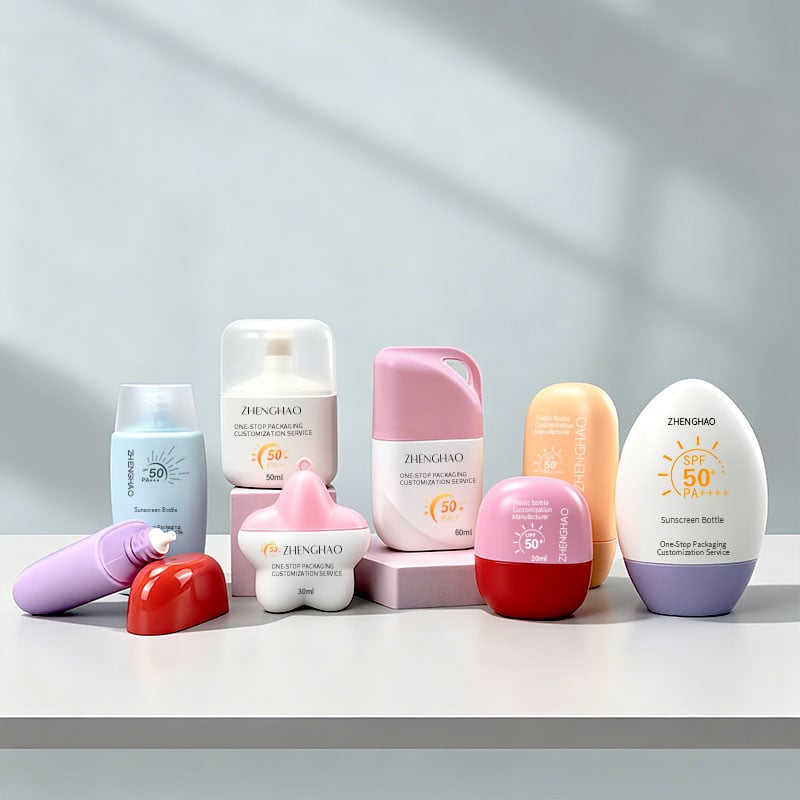
When a consumer reaches for sun protection on a crowded shelf, they make a split-second call based on one thing: the sunscreen bottle in front of them. Shape, color, hand-feel — these decide whether your product gets picked or passed. For brands in the sun care market — valued at $15 .47 billion globally in 2025, projected to exceed $25 billion by 2034 — that sunscreen bottle is not a container. It is the first pitch.
Behind that shelf appeal lies a web of engineering most brand owners never think about until late in development. Material compatibility. Dispensing mechanics. Export compliance. Sustainability demands customers now read before they buy. This article walks through what goes into a well-made sunscreen bottle — from the standpoint of a factory that molds and ships these containers every day.
Why Your Sunscreen Lotion Bottle Is More Than Just Packaging?
A sunscreen lotion bottle does one thing most cosmetic containers do not: survive outdoor conditions while keeping a chemically active formulation stable. The sunscreen bottle you choose directly affects real-world performance. UV filters like avobenzone degrade certain plastics. Oxybenzone interacts with low-grade PET. Choosing the right resin — HDPE for squeeze, high-clarity PET for premium, or multi-layer barriers for sensitive SPF — is a formulation decision that lives inside your sunscreen bottle.
Dispensing matters equally. A sunscreen pump bottle must deliver consistent dose control — consumers apply sun protection in specific quantities per body area. Under-dispensing means your SPF claim does not match what reaches the skin, a regulatory risk in the EUnderstanding the Full Lifecycle: From Empty Sunscreen Bottle to Sustainable ClosureU and Australia. Over-dispensing wastes product and erodes perceived value. A manufacturer who understands pump tolerance across different viscosities saves you from costly post-launch fixes.
Consider the real lesson: amid-size US sun care brand launched a 200ml SPF 50 lotion in a standard PET sunscreen bottle with a generic pump. Within six months, complaints about "hard to pump" and "lotion separates at the nozzle" forced a redesign —an estimated $120,000 in tooling changes and dead inventory. The root cause? The pump was never tested against their viscosity range. A sunscreen bottle factory-side compatibility test would have caught it before the first mold was cut.
Choosing the Right Dispensing Format for Your SPF Product
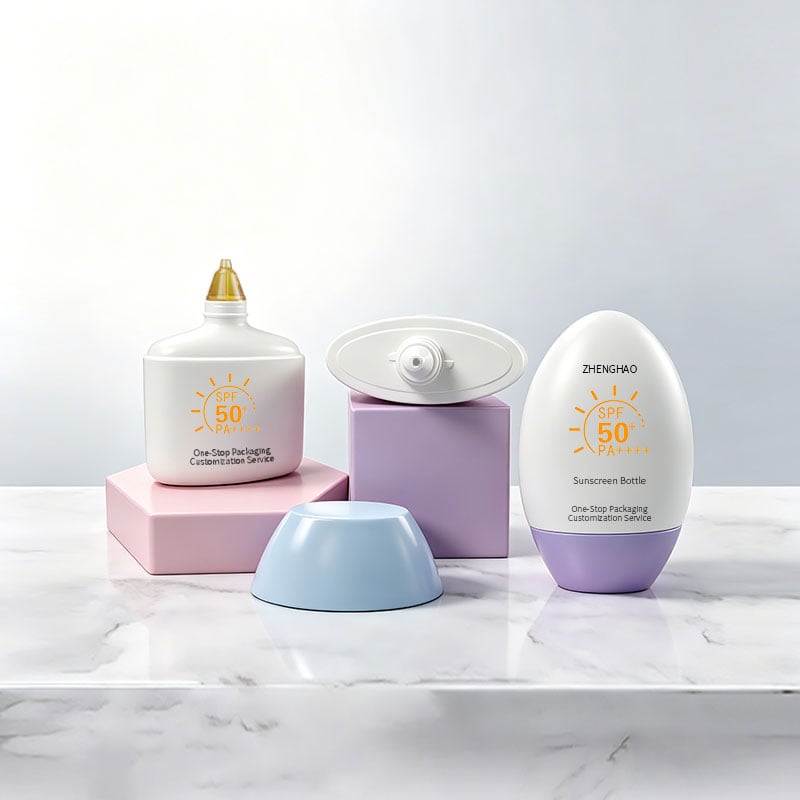
Not every sun protection product wants the same closure. Sunscreen squeeze bottles dominate travel and sport segments —fast, intuitive, and cheap to produce. HDPE squeeze handles thick formulations well, making it the go-to for beach-ready lines and promotional sets. If your sunscreen bottle needs to survive a backpack and a beach bag, squeeze is your safest bet. For brands sourcing sunscreen bottle wholesale quantities — resort amenities, event giveaways — HDPE squeeze offers the lowest per-unit cost at volume.
On the other end, a big bottle of sunscreen — 250ml or 500ml for family or resort applications — almost always calls for a pump. Measured dispensing, cleaner shelves, premium perception that justifies a higher price. Families do not want to wrestle a half-empty squeeze tube.
Then there are compact formats. Mini sunscreen bottles in 30ml–50ml have surged over the past three years, driven by airline liquid limits and "sunstick" lifestyle brands. These require tighter wall thickness control — a 0.1 mm variance at that scale shows as visible asymmetry on the finished sunscreen bottle. A factory with 10,000+ existing molds and a dust-free workshop lets you prototype quickly without committing to a full custom mold run first.
Custom Sunscreen Bottle Design: Where Brand Identity Meets Mold Engineering
Your bottle shape is your brand signature. A yellow bottle sunscreen signals tropical warmth — consumers associate bright yellow with solar energy and outdoor fun. A blue sunscreen bottle positions the product around water, ocean, and cool reliability. These are visual shortcuts from decades of consumer psychology research, working especially well in sun care where purchase context is outdoor, bright, and emotional.Your sunscreen bottle color communicates what your brand stands for before the customer reads the label.
Getting that color right in production is harder than picking a Pantone swatch. Resin colorants shift under injection molding temperatures — a shade that looks perfect in masterbatch can drift half a tone at 260°C in mass production. Surface treatments
each add process control that your sunscreen bottle supplier must have mastered. Skip sample validation, go straight from concept art to bulk, and you will almost always face color drift complaints on your sunscreen bottle.
Beyond aesthetics, a custom sunscreen bottle solves mechanical problems. Wall thickness across oval shapes requires mold flow analysis. Even a simple sunscreen container change — round to oval — means rethinking cooling channels and ejection systems. Every design flourish adds tooling cost but also shelf differentiation. The real question: does your factory partner have the engineering depth to execute at scale without quality drift?
Understanding the Full Lifecycle: From Empty Sunscreen Bottle to Sustainable Closure
Most packaging briefs ignore what happens to your sunscreen bottle after the last drop of SPF. An empty sunscreen bottle in a landfill is an environmental and reputational liability. EU PPWR reforms (2025–2026) push brands toward mono-material designs and recyclability labeling. California's SB 343 does the same. A cute sunscreen bottle that wins on Instagram but cannot be recycled is a future compliance problem.
Practical sustainability means designing the sunscreen bottle for disassembly: mono-material HDPE or PET with recyclable PP caps, minimizing mixed-material pumps, and choosing in-mold labeling over adhesive labels that contaminate recycling streams. A factory with ISO 9001 and Sedex certifications has the discipline to execute these specs consistently.
The economics back this up. A 2025 Personal Care Packaging Council survey found that brands switching to recyclable mono material packaging see a 12–18% increase in repeat purchase intent among consumers aged 25–40 — the core demographic for premium SPF products. That is a measurable revenue argument, not charity.
Sunscreen Bottle Manufacturing: What Brand Owners Should Demand From Their Factory Partner
Every sunscreen squeeze bottle on your shelf started as a tooling conversation on a factory floor. The gap between "we can make that" and "we can make 50,000 sunscreen bottles per day with zero defect variance" is where most supply chain surprises live.
A competent sunscreen bottle manufacturer should deliver three things upfront: material compatibility testing against your formulation, mold flow simulation before you commit tooling fees, and a documented tolerance sheet covering wall thickness, weight, and closure torque. If your sunscreen bottle supplier cannot provide these before the first sample, you are carrying risk that should have been engineered out.
Mold ownership is another lesson brand owners learn too late. When you pay for a custom mold, clarify who holds the physical tool. A factory retaining your mold can switch production schedules without your consent. Insist on mold transfer clauses or exclusivity agreements — especially for shapes central to your brand identity.
For scaling brands, a partner with 10,000+ existing molds and 20+ years of experience offers a shortcut: select proven base shapes, customize finishes and closures, and reach production faster than blank tooling. Zhenghao's 20,000m² facility with an 8,600m² dust-free workshop reflects the infrastructure that separates a sample-capable vendor from a volume-capable sunscreen bottle factory.
For established brands at 100,000+ units, custom tooling amortizes: an $8,000 mold across 200,000 sunscreen bottles adds four cents per unit. At that scale, a unique silhouette or proprietary pump mechanism pays for itself. The key is a manufacturer with vertically integrated systems — injection molding, surface decoration, closure assembly under one roof — so tolerances hold across every step, not just molding.
Sun protection is a growth market with real packaging complexity. Brands that win long-term treat their sunscreen bottle as a strategic product decision — not a last-minute container choice. Choose a manufacturing partner who sees it the same way.
Table of Contents
- Why Your Sunscreen Lotion Bottle Is More Than Just Packaging?
- Choosing the Right Dispensing Format for Your SPF Product
- Custom Sunscreen Bottle Design: Where Brand Identity Meets Mold Engineering
- Understanding the Full Lifecycle: From Empty Sunscreen Bottle to Sustainable Closure
- Sunscreen Bottle Manufacturing: What Brand Owners Should Demand From Their Factory Partner