 EN
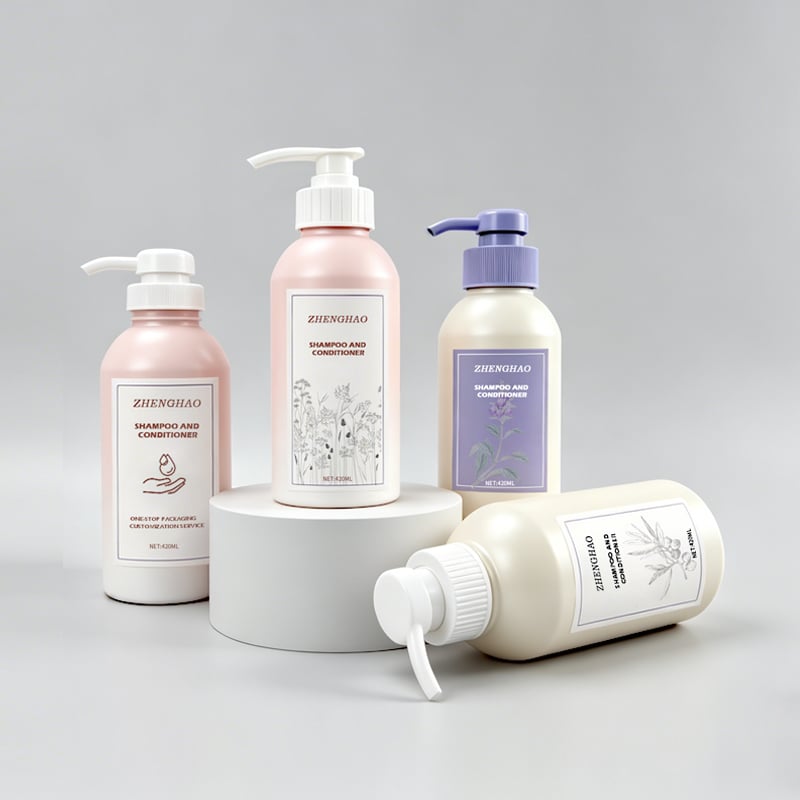
In Summary: Selecting the optimal plastic bottles for shampoo depends on formulation viscosity, target volume, and dispensing mechanics. Thin, watery clarify shampoos are best paired with 250ml–500ml HDPE squeeze bottles or calibrated 24/410 press pumps to prevent over-dispensing. High-viscosity cream formulations require wide-bore 28/410 lotion pumps (2.0cc output) or flexible LDPE squeeze containers to avoid cavitation. For initial market launches, most hair care brands standardize on a 500ml (16 oz) master PET/HDPE bottle geometry to lower mold tooling costs and meet 5,000-unit factory MOQ tiers unit SKU.
Volumetric Sizing and The Overflow Capacity Trap
Setting volume specifications across your product lineup—such as trial sizes, standard retail units, and salon refills—requires analyzing physical bottle dimensions alongside liquid formula behavior. A common mistake during volume allocation is neglecting internal displacement caused by pump dip tubes and closure pistons.
Nominal capacity represents the advertised liquid volume listed on your retail packaging (e.g., 500ml). However, when custom clear plastic bottles for shampoo are filled on automated machinery, liquid cannot reach the very lip of the finish. Brimful capacity measures the total fluid volume a container holds when filled to the exact top edge.
If a factory cuts a mold where brimful volume is only 5% higher than nominal capacity, inserting a heavy-duty lotion pump will force shampoo to overflow down the outer bottle walls during assembly. For standard 16 oz plastic bottles for hair care, engineering a 10% to 12% head-space bufferabove nominal volume is mandatory to accommodate internal pump displacement and thermal fluid expansion.
| Skincare/Haircare | Nominal Capacity | Brimful Capacity | Target Neck Finish |
| Travel & Trial Sizes | 60 ml - 250 ml | 72 ml - 115 ml | 20/410 or 24/410 |
| Standard Retail Bottles | 250 ml (8 oz) | 275 ml - 285 ml | 24/410 or 28/410 |
| Value / Family Packs | 500 ml (16 oz) | 545 ml - 560 ml | 28/410 |
| Professional Salon Bulk | 1000 ml (32 oz | 1080 ml - 1100 ml | 28/410 or 33/410 |
Neck Finish Matching for Custom Shampoo Bottles
A frequent point of friction between brand owners and bottle suppliers is closure mismatch. A cap that turns smoothly by hand may leak under vacuum decay testing or bind on an automated torque capping machine.
Deconstructing SPI 410 Thread Specs
The standard neck designation for personal care packaging—such as 24/410 or 28/410—follows the Society of the Plastics Industry (SPI) guidelines. The first number (28) represents the outer thread major diameter in millimeters. The second number (410) designates the thread style, specifying a single-thread turn completing 1.5 rotations.A bottle neck is a functional interface, not a decorative ring. It determines how the bottle joins with a flip-top, disc top, pump, or screw closure. A 24/410 or 28/410 callout identifies a widely used neck-and-thread family.
The first number indicates nominal neck diameter and the second identifies thread style. A 24/410 closure should not be assumed to fit a 28/410 neck. Similar-looking components can differ in thread engagement, gasket behavior, actuator height, dip-tube length, or sealing contact. Test the bottle, cap, and closure as one assembly.
To achieve a 100% leak-proof seal across plastic bottles for shampoo and conditioner, neck dimensions must adhere to strict tolerances:
 T-Dimension: The outer diameter of the neck thread. Deviation exceeding ±0.15mm causes capping chucks to strip threads.
E-Dimension: The outside diameter of the neck wall. This dictates internal cap plug clearance.
I-Dimension: The inner diameter of the bottle mouth. If the I-dimension varies on small plastic bottles for shampoo, internal pump dip tubes may bind during high-speed insertion.
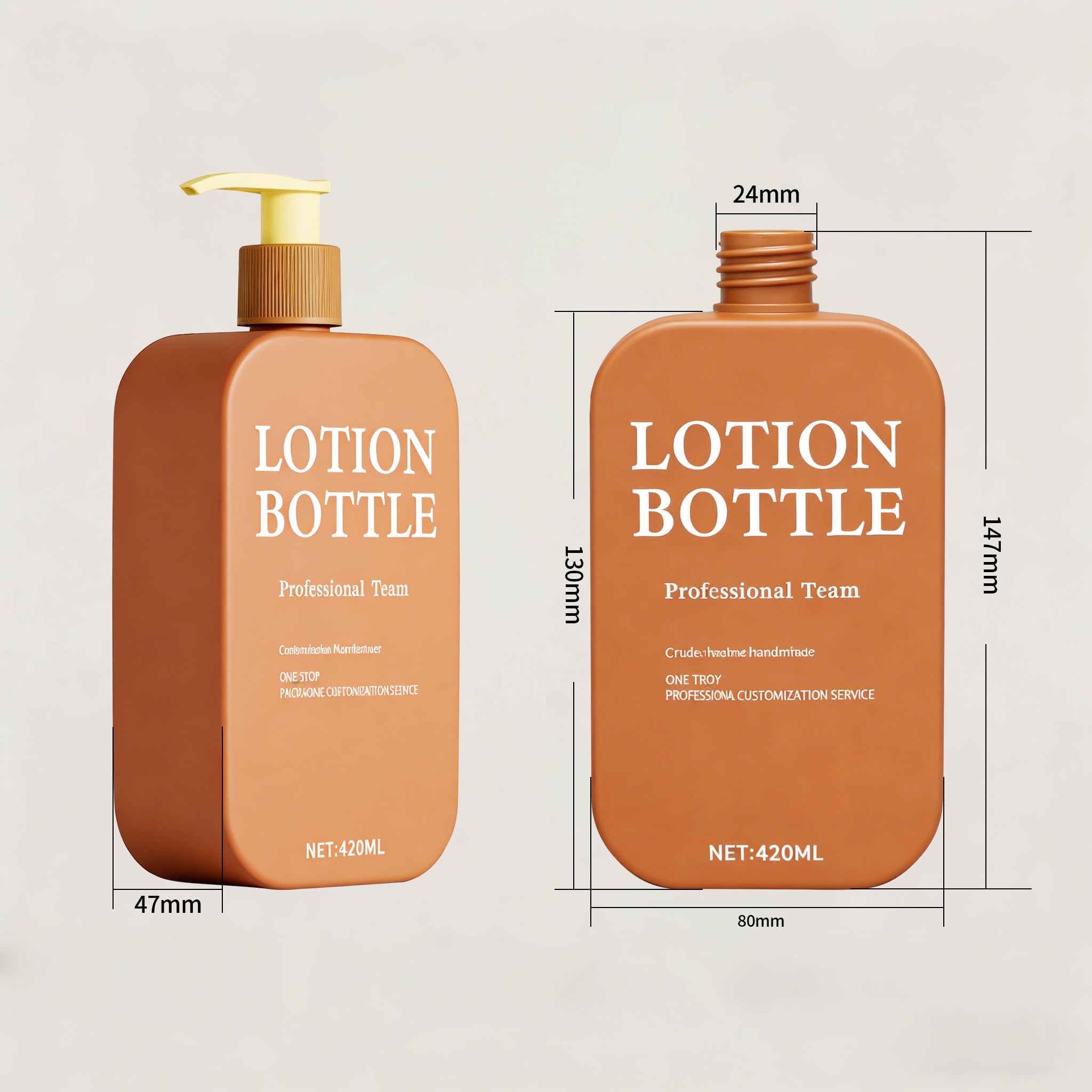
Plastic bottles for shamoo:500ml with 24mm/410 neck size
Molding Technologies: EBM vs. ISBM
Choosing between Extrusion Blow Molding (EBM) and Injection Stretch Blow Molding (ISBM) impacts bottle clarity, impact resistance, and mold tooling investment for empty plastic bottles for shampoo lines.
Extrusion blow molding (EBM) is the standard route for HDPE shampoo bottles, including squeeze formats. The tooling is comparatively accessible, and the process is forgiving at lower volumes. A typical EBM shampoo bottle program can start in the low thousands—5,000 pieces is a realistic entry point for a custom mold in HDPE.
Injection stretch blow molding (ISBM) produces PET bottles with the clarity and wall control that EBM cannot match, which is why it dominates clear cosmetic formats. But ISBM starts from an injection-molded preform, and the tooling includes both the preform mold and the blow mold. The entry volume is higher—50,000 pieces is the order of magnitude, not 5,000.
That gap is not a negotiating tactic. It is the math of amortizing two tools and a preform development cycle across a production run. If your brand is launching a clear shampoo bottle in a test market, an ISBM program may be the wrong first move. The smarter sequence is often an EBM opaque bottle for the launch volume, with the clear ISBM format held for a proven SKU.A reliable factory should explain these trade-offs before quoting, not present a new mold as the only serious choice. The best package is the one that creates distinction without forcing unnecessary inventory or production risk.
| Manufacturing route | Often suitable for | Commercial advantage | Budget separately for |
| Existing bottle + stock closure | Early launch or market test | Faster sampling and lower tooling exposure | Custom color, decoration, labels, assembled closure |
| Existing bottle + custom color/print | Range extension or brand refresh | Keeps proven geometry while improving shelf identity | Color matching, artwork approval, setup per variation |
| New custom mold | Differentiated hero range or long-term program | Ownable silhouette and integrated design details | Tooling, trial runs, validation, drawing approval, longer development |
SKU Splitting, MOQ Structure, and Unit Cost Scaling
For scaling cosmetic personal care brands launching multiple product variants—such as shampoo/conditioner/body wash—managing Minimum Order Quantity (MOQ) constraints is critical to maintaining healthy cash flow.
The Unified Geometry Strategy
The highest manufacturing cost barrier occurs during color changes and machine setup. If a brand orders three different custom bottle shapes for three SKUs, each requires a separate $1,000 mold set and individual 5,000-unit production runs.
Some procurement managers use a unified bottle silhouette. By maintaining identical outer bottle dimensions across your line, a plastic bottles for shampoo wholesale factory can run a single 30,000-unit master molding batch. Individual SKU differentiation is then achieved through custom masterbatch color injection, soft-touch spray coatings, or silk-screen labeling.
Pre-Production Testing Protocols
Before signing off on full-scale manufacturing, custom production orders must pass three mandatory quality control steps:
Vacuum Decay Leak Testing: Sealed filled bottles are placed under -0.08 MPa vacuum pressure for 5 minutes to ensure zero closure seam weeping.
Top-Load Compression Testing: Measuring vertical crushing force to guarantee containers survive pallet stacking during maritime freight.
Product Formulation Compatibility: Testing bulk formula against inner bottle walls for 45 days at 45°C to rule out paneling or plasticizer leaching.
Partnering with Zhenghao Packaging for Custom OEM/ODM Production
Transitioning your custom bottle packaging from preliminary concepts to automated production lines requires a partner with deep mold-building expertise and rigorous technical standards. As a specialized B2B supplier and direct manufacturing factory, Zhenghao Packaging provides complete end-to-end container engineering.
Our customized manufacturing solutions include:
In-House Tooling Development: Precision CNC mold cutting for custom bottle profiles, ergonomic hand grips, and embossed logos.
Flexible Resin Formulations: Production options utilizing virgin PET, HDPE, LDPE, and certified Post-Consumer Recycled (PCR) resins from 30% to 100%.
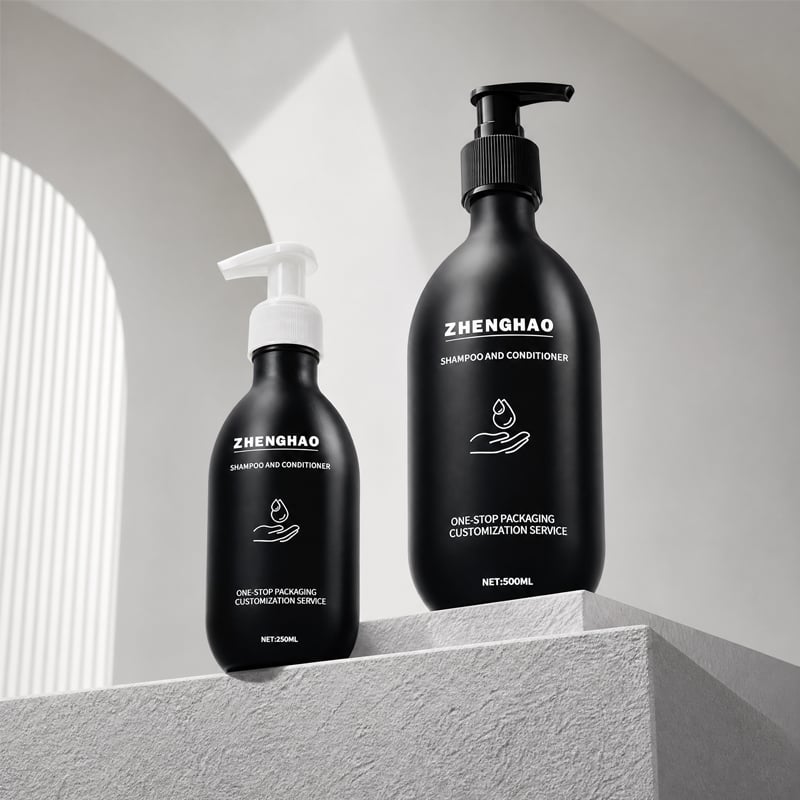
Plastic bottles for shampoo :250ml and 500ml with same design
What Factors Determine the MOQ for Custom Plastic Shampoo Bottles?
The Minimum Order Quantity (MOQ) for custom shampoo bottle packaging is not a single rigid industry figure. Instead, it is calculated from the sum of three distinct manufacturing cost structures. A custom requirement in any of these three areas will directly increase the MOQ threshold:
1.Mold Availability: Existing Stock Molds vs. Custom Tooling
Using existing factory molds (such as standard 250ml or 500ml round/oval profiles) allows for custom color injection at significantly lower MOQ tiers (typically 5,000 units). However, if your brand requires a unique ergonomic silhouette or custom structural embossing, dedicated Injection Stretch Blow Molding (ISBM) or Extrusion Blow Molding (EBM) tooling must be engineered. Because initial mold design, machining, and line setup costs are amortized over the production run, custom tooling pushes the minimum order requirement up to 10,000–20,000 units.
2. Surface Decoration & Coating Complexity (Matte & Soft-Touch Finishes)
Standard pressure-sensitive labeling or single-color silk-screen printing carries the lowest MOQ requirements (around 5,000 units). However, adopting trendy high-end aesthetic treatments—such as matte spray coatings or soft-touch tactile finishes—requires secondary offline spray lines and high-temperature curing. Due to paint batch formulation overhead and higher initial setup scrap rates, requesting soft-touch or matte finishes will raise the minimum order quantity to 10,000+ units per SKU. Additional steps like multi-color hot stamping or electroplated metallic accents further elevate minimum production runs.
3. Dispensing Mechanism & Component Customization
Shampoos and conditioners rely on lotion pumps with precise output volumes. Selecting standard off-the-shelf pumps in stock colors (white, black, or natural clear) keeps order minimums flexible. However, if your design calls for custom actuator shapes, specialized high-viscosity internal spring engines, or bespoke colors (such as metallic gold or custom Pantone shades), component suppliers cannot pull from ready stock. Custom pump production requires dedicated plastic injection runs and automated assembly, forcing the overall packaging order MOQ up to 10,000 or even 20,000 units.
Partnering with Zhenghao Packaging for Custom OEM/ODM Production
Transitioning your custom bottle packaging from preliminary concepts to automated production lines requires a partner with deep mold-building expertise and rigorous technical standards. As a specialized B2B supplier and direct manufacturing factory, Zhenghao Packaging provides complete end-to-end container engineering.
In-House Tooling & 5,000+ Existing Molds: Rapid custom mold development via precision CNC cutting, combined with an extensive library of over 5,000 existing bottle molds to lower upfront tooling costs and speed up product launch.
Advanced Blow Molding Fleet (10+ EBM & ISBM Lines):Equipped with more than 10 high-speed Extrusion Blow Molding (EBM) and Injection Stretch Blow Molding (ISBM) production lines, ensuring consistent wall thickness distribution across both flexible HDPE/LDPE and crystal-clear PET packaging formats.
3+ Precision Printing & Micro-Delta E Color Matching: Operating 3+ multi-color automatic screen printing and hot-stamping machines integrated with a low-variance color management system, maintaining strict batch-to-batch color consistency for custom brand identity.
Automated Optical QC & Leak Inspection System: Fully integrated automated optical inspection (AOI) and inline vacuum leak testing systems measuring critical neck finish dimensions down to $\pm 0.15\text{ mm}$ for 100% leak-proof reliability.
Are you ready to obtain the packaging quotation for the shampoo plastic bottles? Please send us your formula type, target specifications and order quantity. We will provide you with specification suggestions, decoration plans and sample production schedules.
Click Here Send Inquiry To Us !
Table of Contents
- Volumetric Sizing and The Overflow Capacity Trap
- Neck Finish Matching for Custom Shampoo Bottles
- Molding Technologies: EBM vs. ISBM
- SKU Splitting, MOQ Structure, and Unit Cost Scaling
- What Factors Determine the MOQ for Custom Plastic Shampoo Bottles?
- Partnering with Zhenghao Packaging for Custom OEM/ODM Production